
Why Does My Hair Take FOREVER to Dry?
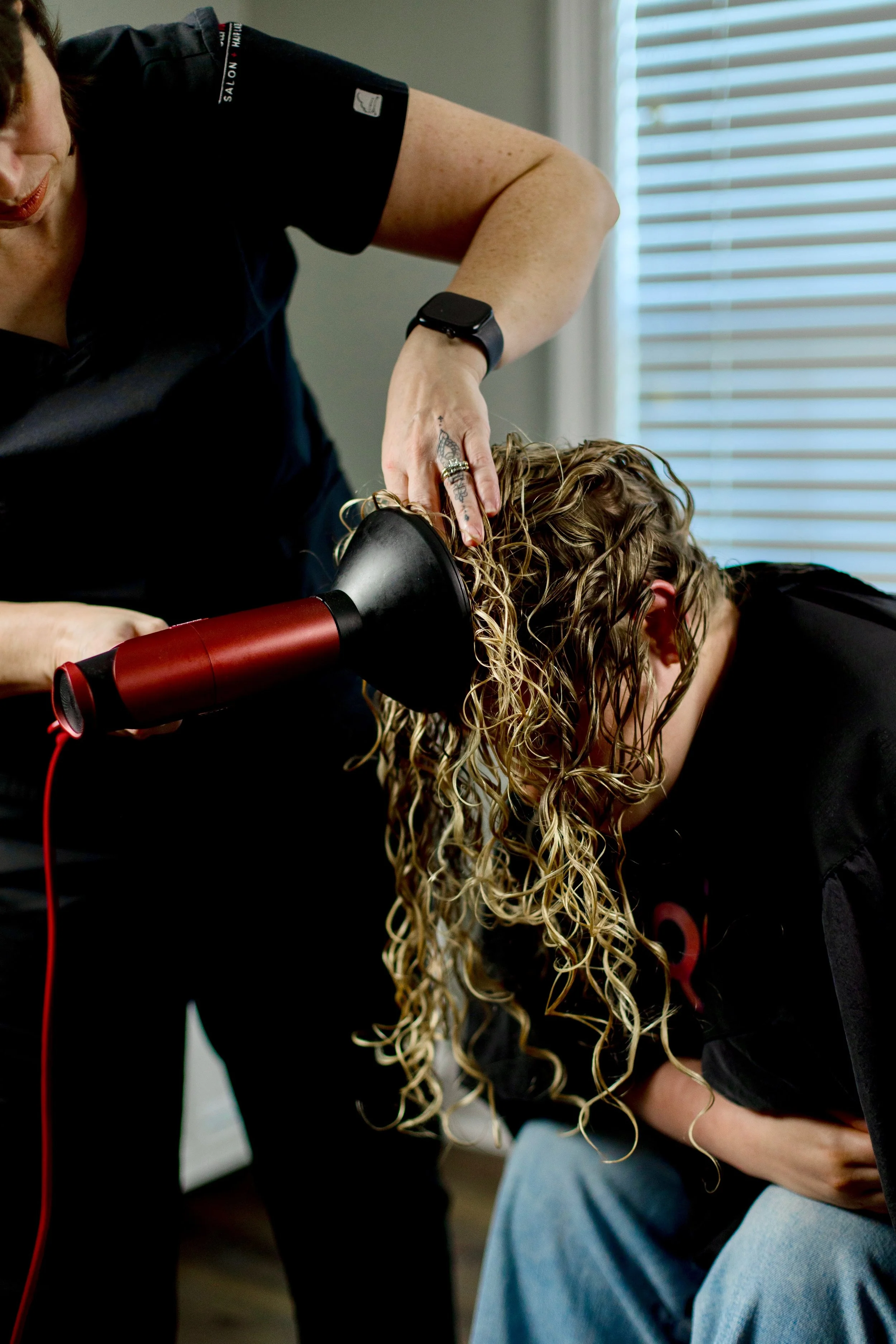
You washed your hair hours ago.
You have somewhere to be, but you're still standing there with a diffuser aimed at the same section you swear you've already dried three times. The outside feels dry. You reach underneath and somehow it's still damp.
If you have curls, you've probably heard the explanation: You have low-porosity hair.
Maybe.
But here's something most curl conversations leave out: drying time isn't a porosity test.
It's a clue.
And once you know what else can affect drying time, you may start looking at your hair very differently.
Porosity Became a Shortcut
Porosity is real. Hair is naturally porous, and its structure influences how water and other substances move through the fiber. Chemical and physical damage can alter that permeability too. Researchers don't determine these changes by timing someone's wash day, though. They use methods capable of examining swelling, permeability and structural changes within the fiber.
Yet somewhere between the laboratory and social media, something complicated became remarkably simple:
Takes forever to get wet or dry? Low porosity.
Gets wet and dries quickly? High porosity.
The problem isn't the terminology. It's believing one observation proves the explanation.
A symptom is not a diagnosis.
First, How Much Hair Are You Drying?
Here's the first thing that gets overlooked: drying a strand of hair and drying a head of hair aren't the same experiment.
Density matters. Strand size matters. Length matters. So does the way thousands of wet strands sit against one another.
Then consider what curly-haired people deliberately do when styling: we create clumps. We encourage wet strands to stay together because that's how we create beautiful definition. The hair underneath may consequently have considerably less exposure to moving air than the curls sitting on top.
Airflow matters enough that researchers studying hair-drying efficiency have demonstrated different moisture-removal patterns simply by changing how airflow is distributed.
So before deciding your hair dries slowly because water can't escape the fiber, ask another question:
Can air efficiently reach all of it?
Now Let's Make It More Interesting
What if the water isn't interacting with your hair the way you think it is?
Every leave-in, cream, gel, oil and conditioning treatment becomes part of the environment surrounding the fiber. Even metal and mineral deposits from your water and whatever the great outside graces us with deposits on the hair. And over time, some materials can accumulate.
This is where things get particularly interesting.
Researchers studying oil-treated human hair found that surface films reduced moisture uptake and substantially slowed moisture diffusion. When that film was removed, the hair's moisture behavior shifted back toward that of untreated hair.
Think about the implication.
Water seems reluctant to penetrate your hair. Products appear to sit on top. Your hair takes forever to dry.
You've been told those are signs of low porosity.
But buildup can create some of the same observations.
That doesn't mean every coating is bad. Cosmetic ingredients are often intended to deposit on the fiber because they can improve lubrication, manageability and appearance.
The important question is different:
Are you observing the behavior of your hair—or the behavior of what's currently sitting on it?
That's the part worth remembering the next time someone diagnoses their porosity from drying time alone.
If you enjoy being the person in the room who knows why these things happen, follow us on Facebook and Instagram. This is the kind of curl science we believe deserves to make it beyond the laboratory.
And Then There's the Hair Itself
Suppose we remove buildup and evaluate the actual fiber.
We're still not done.
Hair has a history.
Chemical processing, heat, UV exposure and mechanical wear can alter its structure and permeability. Recent research on textured hair has demonstrated measurable changes in water permeability and surface structure following chemical and physical damage.
And here's another detail worth knowing: the ends of your hair and the hair near your scalp aren't the same age.
Your newest growth may have experienced months of life. Your ends may carry years of it.
So different areas of the same head can behave differently around water without requiring us to assign the entire head one simple label.
Drying behavior is information. It needs context.
Even Air-Drying Isn't as Simple as We Were Told
For years, conventional wisdom has treated air-drying as the automatically gentler choice.
Research complicates that story too.
In one study, higher blow-dryer temperatures produced progressively more surface damage. That's not particularly surprising. But researchers also observed Cell Membrane Complex (CMC) damage in the naturally dried samples, which remained wet for more than two hours. They proposed prolonged swelling during water exposure as a possible explanation and emphasized the need for further study.
That does not mean air-drying is bad.
It means “always air-dry” is another beautifully simple answer to a question that isn't beautifully simple.
Hair science does this to us constantly.
What About the Porosity Tests You've Seen Online?
That's another conversation and one we'll have in a future article.
For now, know that popular home porosity tests aren't reliable enough to turn one observation into a diagnosis. Whether a strand floats, water beads on the surface or your hair takes five hours to dry may tell you something happened.
The interesting question is why.
Your Hair Isn't Supposed to Diagnose Itself
If your hair suddenly starts taking much longer to dry, pay attention.
If one section dries rapidly while another remains wet, pay attention.
Those are useful observations.
But instead of immediately reaching for a label, start asking better questions. What's the density? What's the strand size? What's sitting on the fiber? What has the hair experienced? Has something recently changed? And what happens after the hair is properly cleansed?
That's the difference between labeling hair and assessing it.
Because “my hair takes forever to dry” isn't an answer.
It's evidence.
And if you've spent years collecting curl labels but still don't understand why your hair behaves the way it does, CURLtelligence™ was built to start somewhere different: with your actual hair—its structure, history, condition and behavior.
FOLLOW US ON SOCIAL