
Your Curls Aren’t Growing Slowly. You May Be Losing the Length.
You’ve been growing your hair for what feels like forever.
You’ve avoided the haircut. You’ve taken pictures to compare. Maybe you’ve bought the oils, the serums, the supplements, or the shampoo with growth written across the bottle. Every few months you check again, expecting to finally see the payoff, and somehow your curls seem to be sitting at exactly the same place they were before.
So eventually you come to what feels like the obvious conclusion: My hair just doesn’t grow.
But what if it does?
What if the problem isn’t growing the length at all?
What if the problem is keeping it?
Growing Hair and Keeping Hair Are Two Different Biological Problems
Hair growth begins beneath the surface of your scalp, inside the follicle. The strand that eventually emerges is the result of that biological process. But once that strand leaves your scalp, its challenge changes.
Now it has to survive.
That distinction is incredibly important because hair can leave your head in different ways. A strand can naturally shed from the follicle as part of the hair-growth cycle. It can also break somewhere along the fiber.
Those two things can look very similar when you find hair in the sink, on the floor or tangled around your fingers on wash day, but they aren’t the same process.
The American Academy of Dermatology explains that normal shedding is part of the hair-growth cycle and that excessive shedding and true hair loss are different things. There is even variation within published research over exactly how many hairs constitute “normal” daily shedding—which is one reason I don’t think counting every strand in your shower is particularly useful. (American Academy of Dermatology)
Especially when you have curls.
If you don’t brush or wash your hair every day, naturally shed strands can remain caught among the surrounding curls until you detangle. What looks like a frightening amount of hair on wash day may represent several days of shedding arriving in your hand at once.
I’m much more interested in another question:
Has something changed?
Because if your follicles are producing hair but you’re repeatedly losing pieces from the ends and along the fiber, your hair can be growing without becoming noticeably longer.
That’s length retention.
Then Curls Play a Visual Trick on Us
There is another reason curly hair can seem like it isn’t growing.
It doesn’t travel in a straight line.
Think about pulling a spring apart. The material didn’t suddenly become longer when you stretched it. You simply revealed the length that was wrapped around all those curves.
Your curls do something similar.
Hair scientists study curl as a three-dimensional property of the fiber. The bends, curves and spirals that give your hair its shape also mean that its actual fiber length and the distance it hangs from your scalp aren’t necessarily the same thing. (Cloete et al., The what, why and how of curly hair: a review)
That’s shrinkage.
So now we have at least three different things that someone can mean when they say: “My hair won’t grow.”
The hair may actually be growing but curling back toward the scalp. It may be growing while the ends are breaking at a similar rate. Or there may actually be a change occurring at the scalp. And those problems don’t have the same solution.
If learning the difference between what your curls look like they’re doing and what may actually be happening is useful to you, follow us on Facebook and Instagram. That’s what we spend so much time talking about: not giving you another rule for curly hair but helping you understand the hair that’s actually on your head.
Your Ends Have Been Through Some Things
Now think about the oldest part of your hair. Your ends.
If you have twelve inches of hair, those ends didn’t arrive yesterday. They’ve been with you through countless shampoos, detangling sessions, ponytails, pillowcases, sunny days, blow dryers, color appointments and all the little things we do to our hair without even thinking about them.
Your ends have a history.
And unlike your skin, the hair fiber outside the scalp cannot heal itself biologically when it’s injured.
That doesn’t mean damaged hair is hopeless or that every curly strand is destined to break. It means preserving the fiber matters if your goal is retaining length.
Mechanical wear matters. Chemical history matters. Heat matters. The condition of the fiber matters. How you detangle matters.
The American Academy of Dermatology even includes reducing breakage as part of its guidance for caring for fragile or thinning hair. (American Academy of Dermatology)
Which brings us to something interesting we’ve been observing in our own salon.
We Keep Hearing the Same Thing From Our Clients
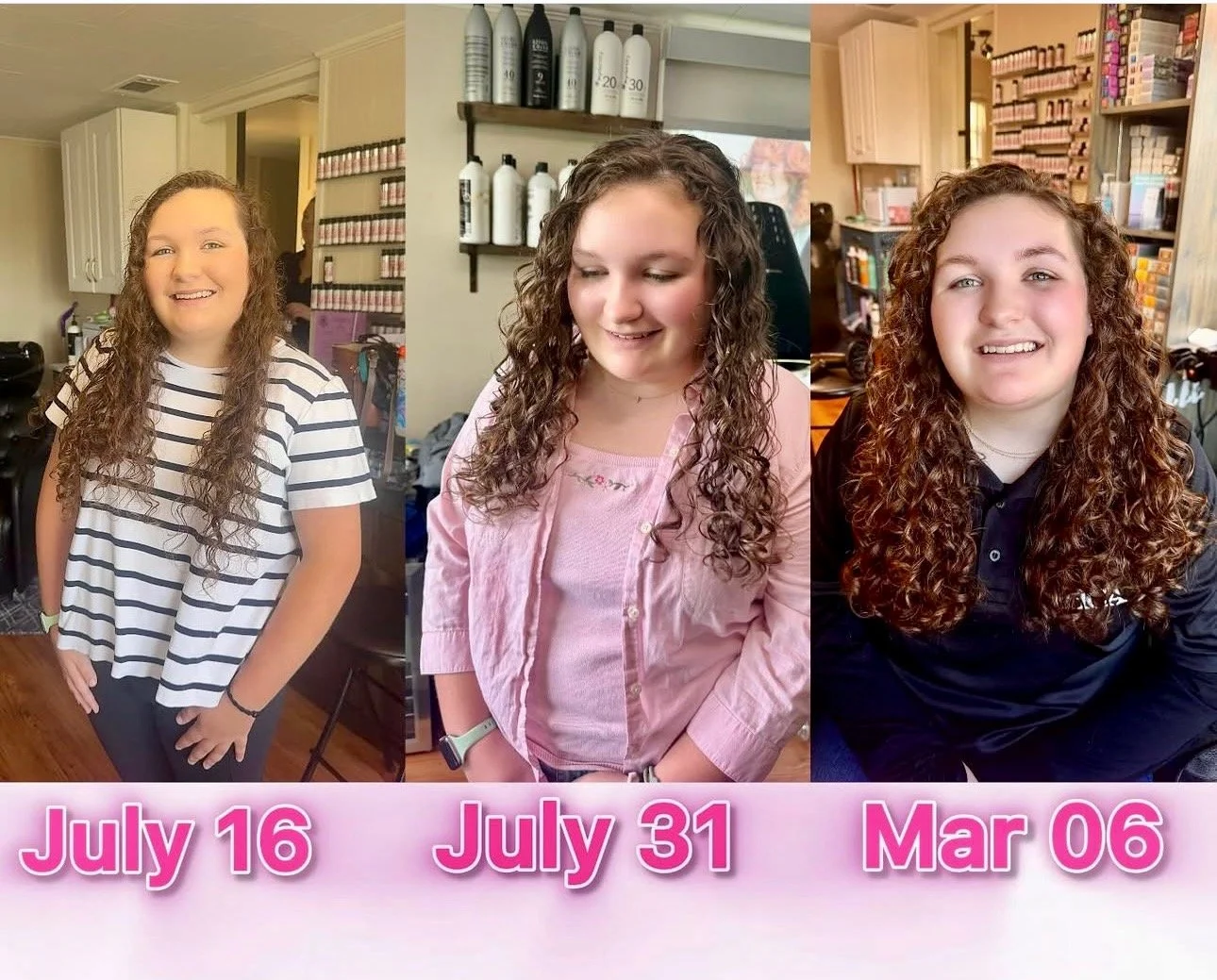
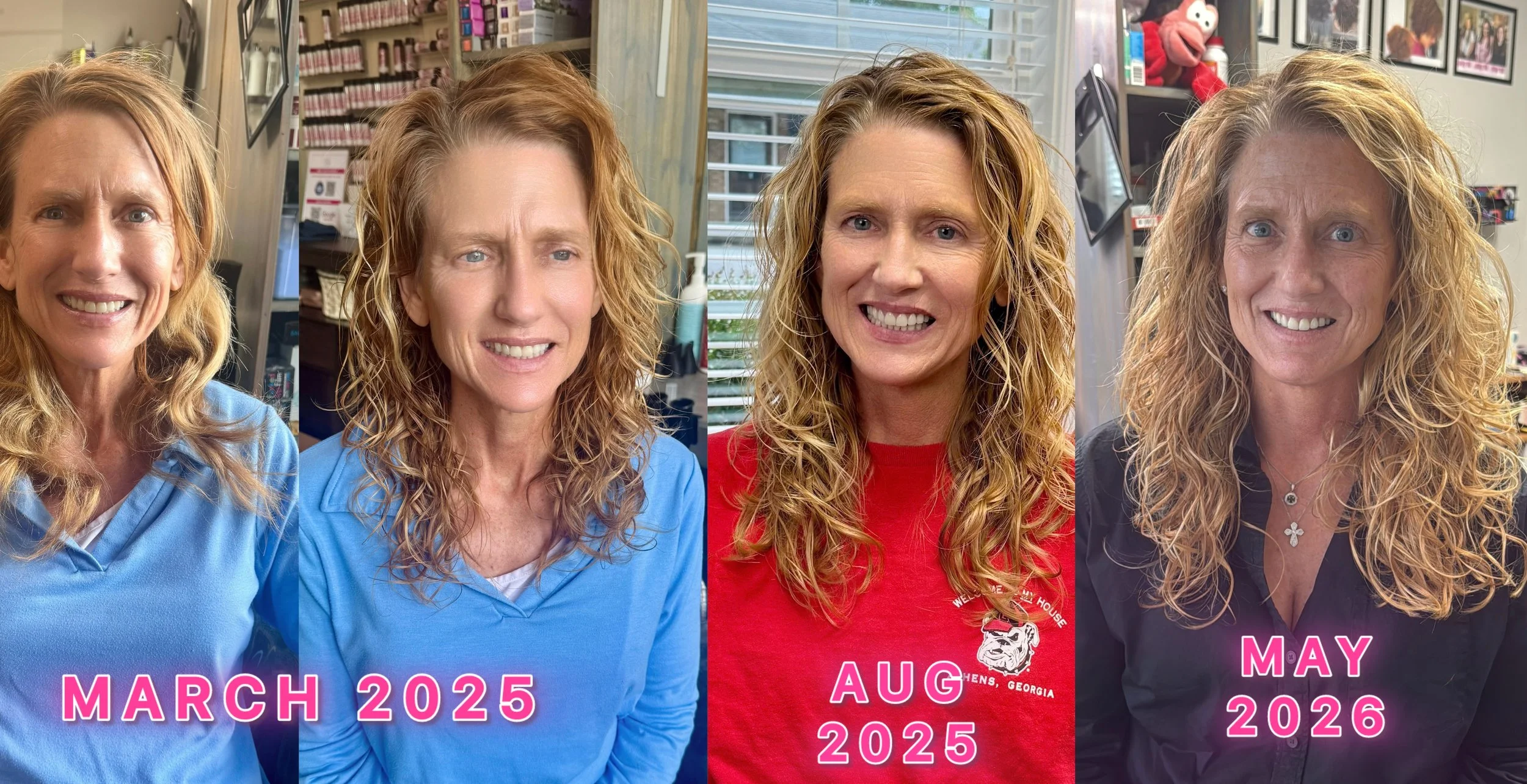
Many of our long-term clients tell us their hair is getting longer.
It isn’t the only change they report. We hear about changes in manageability, appearance, curl behavior and the overall way their hair feels and performs over time.
Those observations are exciting. But they aren’t laboratory evidence. And I think that distinction matters.
We can show photographs. We can document what we see behind the chair. Our clients can tell us what they’re experiencing. But if we want to understand why we’re seeing those changes—and whether they can be objectively measured—we need to take the next step.
So, we are.
We’re in the early stages of collaborating with a researcher to explore how what we’re observing through our CURLTelligence approach might be studied scientifically. The goal is to move beyond “we see this happening” toward measurable evidence that can help us understand what is happening within the hair fiber and why.
That’s the part that excites me most.
There are no guarantees about what research will ultimately show. That’s the entire point of doing research.
But when enough people independently start telling you, “My hair has never gotten this long before,” I think that’s a question worth investigating.
But There Is an Important Line We Won’t Cross
Not every length problem is a salon problem.
If your normal shedding suddenly changes, your density is decreasing, you notice thinning or bald areas, your scalp is behaving differently, or your hair truly appears to have stopped growing, that deserves medical attention.
A dermatologist is trained to diagnose disorders affecting the hair and scalp. The American Academy of Dermatology emphasizes that identifying the cause of hair loss matters because different causes require different approaches. (American Academy of Dermatology — Hair Loss)
That’s not something we want to blur.
Our expertise is the hair fiber and the factors within our professional scope that can affect its condition, performance and preservation.
Sometimes the most knowledgeable thing a beauty professional can tell you is, “This needs to be evaluated by someone else.”
Maybe Your Hair Has Been Growing All Along
So, the next time you look in the mirror and think your curls simply refuse to grow, don’t immediately assume your follicles aren’t doing their job.
Look closer.
Is your hair longer when you stretch it?
Are your ends becoming thinner?
Are you finding short broken pieces?
Has your shedding actually changed from what’s normal for you?
Are you retaining the hair you’re growing?
Because perhaps the question was never: “Why won’t my hair grow?”
Perhaps the better question is: “What is keeping me from keeping the length I’m already growing?”
And once you know to ask that question, you know something a lot of people who are still buying their next miracle “growth” product don’t.
Growing hair and keeping hair are two different biological problems.
Know somebody who has been trying to “grow their hair” for years without getting anywhere? Send them this article. You may give them a question they didn’t know they needed to ask—and sometimes the right question changes everything.
And if you’d rather hear us talk through it, visit our Video Page for the accompanying video. We’ll break down growth, shedding, breakage, retention and shrinkage so you can start looking at what your own curls are actually telling you.
FOLLOW US ON SOCIAL