
Why Are the Ends of My Curls So Different From the Rest of My Hair?
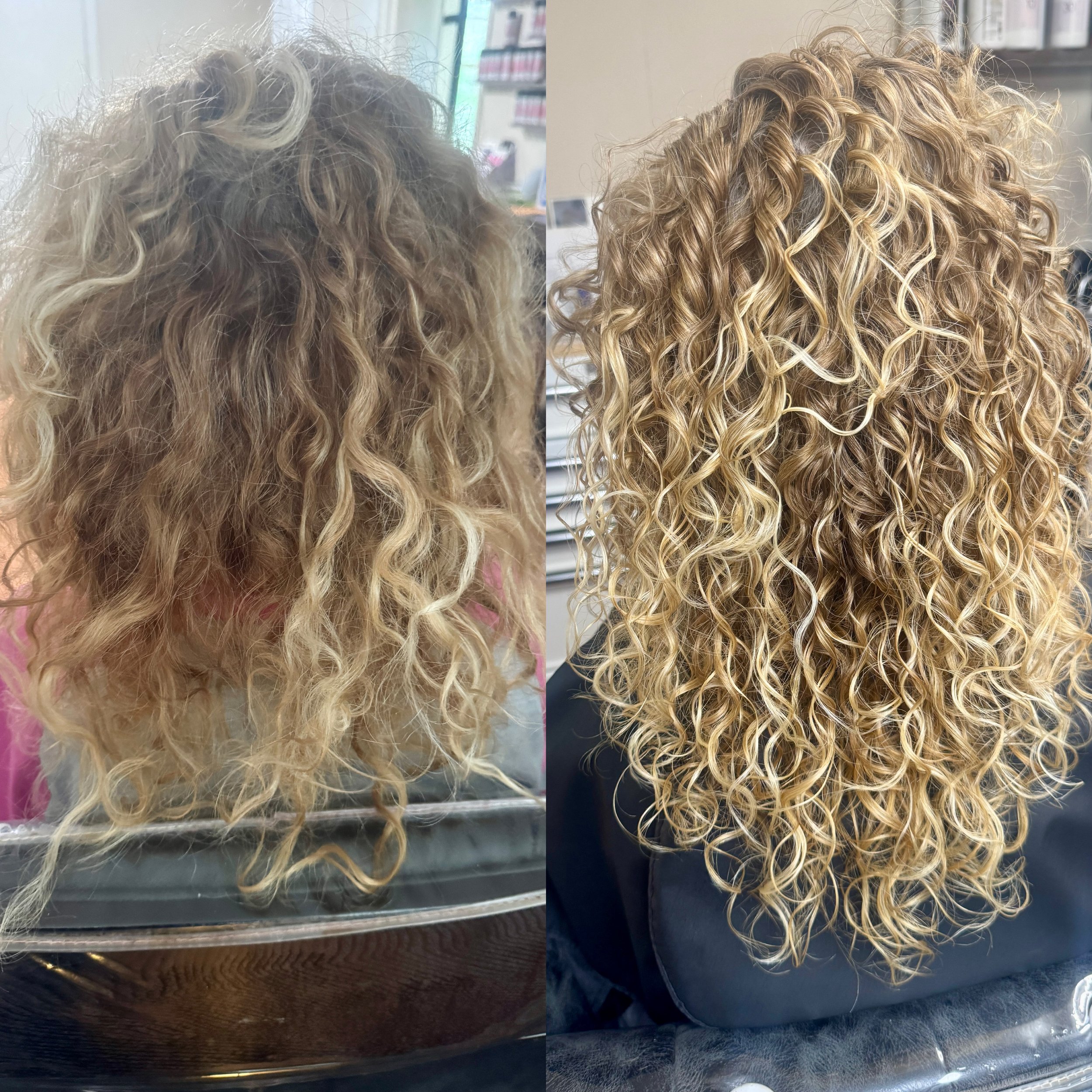
You style your hair, watch the curls near your roots begin to take shape, and think, There they are. They look fuller, springier and more defined. Then your eyes travel toward the ends, where the pattern becomes looser, thinner, rougher or almost transparent. Sometimes the difference is so dramatic that the two sections seem as though they belong to entirely different heads of hair. You may assume you naturally have several curl patterns, and you might, but that is not the only possible explanation.
Your hair may also be showing you its history.
The hair closest to your scalp is the newest part of the strand. The ends may have been with you for several years, which means they have experienced more wash days, detangling, sunlight, heat, friction, color services and environmental exposure. Even careful routines create some wear over time because hair does not biologically heal once it leaves the follicle. Every inch becomes a record of what the strand has encountered and how well its structure has been preserved. The difference you see from roots to ends may therefore reveal more than your natural curl pattern alone.
This matters because curl pattern is often treated as though it were a permanent visual label. You look at the shape your hair makes and assume that appearance tells you everything you need to know. In reality, what you see is influenced by both the structure the strand was born with and its present condition. Hair that is well supported may express its curvature differently from hair that has accumulated significant wear. Sometimes what appears to be a looser curl pattern is actually a section of hair struggling to behave like itself.
One part of that story involves the protective lipids within and around the hair’s structure. When those lipids become depleted, the strand becomes less effective at regulating the movement of water and maintaining the internal environment the cortex needs. The result may be hair that feels dry again soon after styling, frizzes quickly or cannot maintain definition for long. The curl may initially form, only to lose its shape as the day continues. This does not necessarily mean you chose the wrong gel or failed to use enough of it.
Protein structure matters too. Keratin chains and the molecular connections supporting them help give a hair strand strength, elasticity and structural stability. Oxidative color, lightener, chemical texture services, UV exposure, excessive heat and cumulative weathering can affect this network while also damaging other parts of the fiber. These forms of damage are distinct, but they often occur together because many of the same exposures contribute to them. As the internal structure becomes less cohesive, the ends may stretch without recovering well, lose curl formation or break under stresses they once tolerated.
If your roots and ends behave like two different heads of hair, pause before buying another product to force them into agreement. Follow us on Facebook and Instagram as we continue explaining what your curls may be communicating beneath the surface. Understanding the difference between a styling problem and a structural problem can save you considerable time, money and frustration.
Breakage adds another piece to the picture. When weakened strands repeatedly fracture through the lengths, the ends gradually lose density even if the scalp is producing plenty of hair. That can create a full appearance near the roots with ends that look thin, uneven or, using the word many clients bring into the salon, scraggly. The perimeter may seem as if it never grows, when the real problem is that it cannot retain the length being produced. You may be seeing the cumulative outcome of many small breaks rather than one dramatic event.
Not every variation signals damage, however. Different follicles can naturally produce different degrees of curvature, and a single head of hair may contain waves, curls and coils. Hormonal changes, changes in growth and previous chemical services can also influence what you observe. The goal is not to treat every looser section as something that must be corrected. It is to stop assuming that every visible difference is simply “your curl type” without considering what else the strand may be revealing.
This is where specialized assessment becomes more valuable than another round of guessing. The same visible symptom can have several possible causes. Rough ends could involve surface wear, lipid depletion, buildup, structural compromise or a combination of factors. Hair that will not hold definition could be under-supported, coated, weakened or simply being styled in a way that does not match its present needs. Appearance gives us clues, but it does not provide the entire diagnosis by itself.
At Beautifully You Salon + Hair Lab, we look beyond the curl’s visible shape to consider how the strand is behaving, where that behavior changes and what its history may help explain. That deeper understanding allows us to distinguish between hair that needs different styling and hair whose condition must be addressed before styling can deliver a meaningful result. We do not need to reveal every part of our process for you to understand the most important truth: your ends are not betraying you. They may be documenting what they have survived.
The next time you compare your roots with your ends, do not ask only, “Why is my curl pattern different here?” Ask, “What might this part of my hair have experienced that the newer growth has not?” That question can completely change the direction of your curl care.
What difference do you notice most between your roots and ends—curl definition, texture, thickness, dryness or breakage? Share it in the comments. Your answer may help someone else recognize that what they have been calling their curl pattern could also be part of their hair’s history.