
Why Do My Curls Look Better Wet Than Dry?
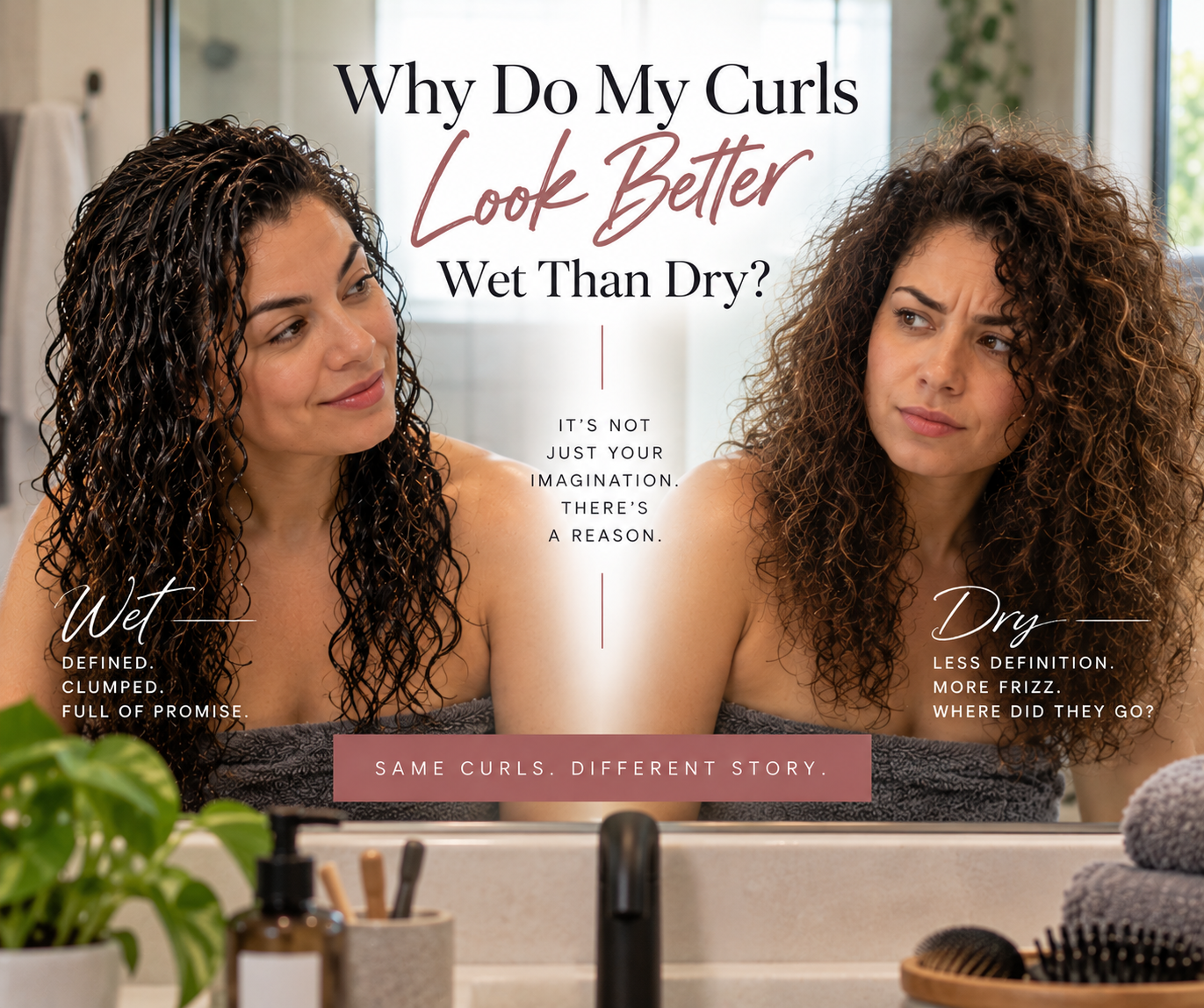
You know the moment. You’re standing in front of the mirror with soaking-wet hair, and there they are. The curls you have been trying to achieve. They’re clumped, defined and somehow doing exactly what you wish they would do every day. For a few glorious minutes, you think, There they are. I knew my curls could do that.
Then your hair dries.
The clumps separate. Some curls stretch. Others become frizzy. By the time your hair is completely dry, you’re wondering where those beautiful wet curls went.
It’s tempting to blame the gel, your technique or even your hair. But the difference between your wet curls and your dry curls may actually be telling you something.
Water Does More Than Make Your Hair Wet
Your hair isn’t simply the same structure with water sitting on top of it. Water temporarily changes how the hair fiber behaves.
Hair is primarily made of keratin proteins held together through several types of chemical interactions, including strong disulfide bonds and much weaker (but extremely numerous) hydrogen bonds. When hair becomes wet, water reduces the contribution of many of those hydrogen bonds, changing the fiber’s mechanical behavior and making it more flexible.
That means the curl you see soaking wet exists under different physical conditions than the curl you see completely dry.
Water can allow curvature to become more apparent, but seeing a beautiful wet curl doesn’t automatically mean that exact shape should remain when your hair dries.
The more interesting question is: What happens to that curl between wet and dry?
Your Hair Has to Make the Journey
Think of styling wet curls as creating architecture.With the hair hydrated and flexible, we organize strands into curl clumps and encourage their natural curvature. But now that structure has to survive the journey to dry.
Your styling products have a job during that transition. Leave-ins, foams, creams and gels aren’t creating the biological structure responsible for your natural curl. The right combination can, however, support clumping and provide enough hold for the shape you created while wet to remain organized as the water leaves.
If understanding the why behind your curls is changing the way you think about your hair, keep learning with us. Follow us on Facebook and Instagram for more curl science and real-world education, or explore the video section of our website when you want to go a little deeper. Understanding your hair makes it much easier to make informed decisions about what it actually needs.
Because products aren’t the only variable.
How You Dry It Matters, Too
Allow your curls to air dry and something else enters the equation: gravity. Wet hair is heavier. As those water-loaded curls hang, that additional weight can contribute to elongation and less volume in some curls. Support those same curls upward with a diffuser and you change the mechanics. But diffusing isn’t automatically better simply because you’re using a diffuser. Too much airflow can disturb the clumps you carefully created. How you position the diffuser and manipulate the hair can change the finished shape, while excessive heat introduces another concern.
Laboratory research found progressively greater surface damage as drying temperature increased. Interestingly, that same study challenges the idea that air drying is automatically the healthiest choice.
Hair allowed to dry naturally took more than two hours and was the only group in that experiment to show damage to the Cell Membrane Complex, or CMC. Researchers proposed that prolonged swelling from water exposure may have contributed, although they also emphasized that more research is needed. Under their experimental conditions, blow-drying from approximately 15 centimeters away with continuous motion resulted in less overall damage than natural drying.
So the answer isn’t simply “heat bad, air drying good.”
Hair is more complicated than that.
Sometimes the Hair Itself Needs a Closer Look
There’s another possibility when the difference between wet and dry curls is dramatic: the condition of the fiber itself.
The CMC helps maintain connections between structures within the hair and participates in how water moves through the fiber. Lipids are also part of this system, influencing the hair’s relationship with water, its physical properties and how it behaves as conditions change.
That matters because your hair isn’t simply going from “wet” to “not wet.” It is transitioning from one physical state into another.
If the fiber is compromised, the styling support isn’t appropriate, the curls are stretched by water weight, or the drying technique disrupts the structure you created, what looked beautifully organized while wet may look very different once dry.
And several of those things can be happening at once.
Which is precisely why “your hair just needs more moisture” or “you need a stronger gel” can be such inadequate answers.
This is where CURLtelligence™ changes the conversation. We don’t assume disappearing definition automatically means one particular thing. We look at the hair itself—its history, condition, behavior with water, styling support and what happens during drying.
Because the difference between your wet curls and your dry curls isn’t a diagnosis.
It’s a clue.
And understanding that clue can change the way you think about your curls.
Think about your last wash day: what changes the most between soaking wet and completely dry—your definition, frizz, curl shape or volume? Tell me in the comments. I want to know what you’re seeing.
FOLLOW US