
A Curl or Not a Curl: That Is the Question
Why the question we’ve been asking about curly hair may be the wrong one.
Human beings have an incredible ability to create order out of chaos.
We organize books into genres, music into playlists, plants into species, and stars into constellations. We look for patterns because patterns help us make sense of a complicated world. Categories help us communicate. They give us a common language. Most of the time, they’re incredibly useful.
Hair has been no different.
Somewhere along the way, we decided curly hair needed a map. We divided it into numbers and letters, convinced that if we could just identify the right combination—2B, 3A, 3C, 4A—we’d finally unlock the mystery of our hair. We would know which products to buy, which techniques to use, and why our hair behaved the way it did.
It was an elegant idea.
The only problem is that hair never agreed to follow the map.
After years of studying curly hair under magnification, watching it respond to different treatments, and helping clients rediscover what their hair is capable of, I’ve come to believe we’ve been asking the wrong question. The debate has never really been whether waves are curls or curls are coils. The better question is this:
What is your hair actually trying to do?
Because labels describe appearance.
Science explains behavior.
That distinction changes everything.
Take a moment and think about your own hair. Have you ever noticed it looks almost straight one day and noticeably curlier another? Have you wondered whether your waves “count” as curls? Maybe you’ve been told curly products aren’t meant for you, only to find they work better than anything else you’ve tried. Or perhaps you’ve asked two different stylists the same question and walked away with two completely different answers.
You’re not imagining things.
You’re experiencing the limitations of a system that describes what hair looks like instead of understanding why it behaves the way it does.
The truth is, very few people fit neatly into a single number and letter. Most of us have multiple patterns on the same head. The hair around your face may form loose waves while the crown develops spirals and the underneath stretches into elongated curls. Sometimes the pattern even changes along the length of a single strand, beginning with a gentle bend near the root before tightening as it travels toward the ends.
Nature doesn’t work in tidy boxes.
It works on a spectrum.
That’s why I’ve never been convinced the endless pursuit of finding your perfect curl type is the answer. Not because the chart is useless, but because it’s answering a much smaller question than most people think it is.
It tells you what your hair looks like today.
It doesn’t tell you why.
It doesn’t tell you how healthy your hair is. It doesn’t tell you whether buildup is preventing your curls from forming. It doesn’t tell you if your hair has lost essential lipids or whether mineral deposits from hard water are interfering with product performance. It doesn’t explain why your curls seem tighter after restoring your hair’s health or why two people with the exact same curl type can have completely different experiences.
Appearance can only tell you so much.
Behavior tells the rest of the story.
If you’re enjoying these science-backed conversations about curly hair, I’d love to continue them with you. Follow us on Facebook and Instagram, where we regularly share tips, myths, and behind-the-scenes insights into the science of healthy curls. And if someone you know has been frustrated trying to “figure out” their hair, share this article with them. Chances are, they’re asking the same questions.
One of the biggest misconceptions I hear is that wavy hair isn’t really curly hair.
But let’s think about that for a moment.
What exactly is the point where a wave becomes a curl?
Can anyone point to the exact degree of curvature where one suddenly transforms into the other?
Of course not.
Because those boundaries aren’t found in nature. They’re drawn by people trying to describe what they see.
That’s why I prefer to think of hair differently.
Straight hair is one category because it lacks natural curvature. Once hair begins expressing curvature, whether it’s a loose wave, a defined spiral, or a tightly coiled pattern, it belongs to a much broader family of curly hair. Within that family exists a spectrum of expression that ranges from waves to curls to coils. They aren’t competing categories. They’re different expressions of the same underlying behavior.
That perspective changes the conversation.
Instead of asking whether your hair is curly enough to use certain products or follow certain techniques, you begin asking what your hair needs to express its healthiest behavior.
Those are far more useful questions.
Because products don’t respond to labels.
They respond to hair.
A conditioner doesn’t know whether it’s being applied to 2C hair or 3A hair. It responds to strand diameter, lipid condition, porosity, density, buildup, and structural integrity. Two people with hair that appears almost identical may need completely different routines because their hair behaves differently beneath the surface.
This is why chasing a curl type so often leads to overflowing bathroom cabinets filled with products that promised everything and delivered very little.
There is no magical product assigned to every number and letter.
There never was.
Healthy hair isn’t built by matching products to a chart.
It’s built by understanding the science behind the hair in front of you.
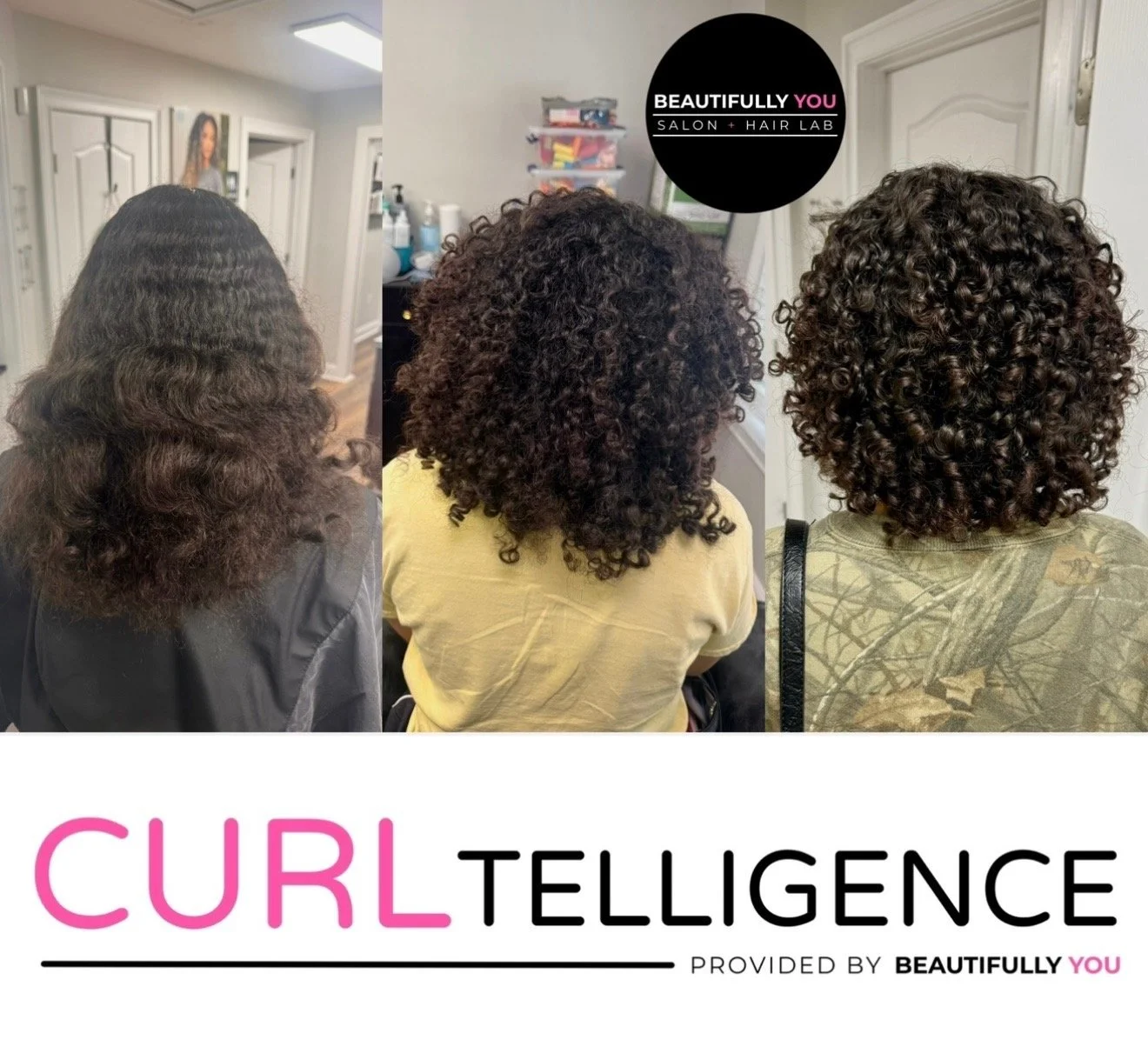
Maybe that’s why so many people discover their hair becomes curlier after restoring its health. Their curl pattern didn’t suddenly change. Their hair simply became free to express the behavior it was capable of all along.
Imagine spending years believing your hair was “just frizzy” when it was actually dehydrated. Or believing it was “just wavy” when layers of buildup had been suppressing its natural movement. Imagine making every decision based on what your hair looked like rather than understanding what it needed.
That’s the difference between labeling and learning.
One places your hair into a category. The other helps you understand it.
At CURLtelligence™, that’s the shift I hope every client experiences. I don’t begin by asking what curl type you have. I begin by asking what your hair is communicating. Because every strand tells a story, and when you learn how to read that story, everything else starts making more sense.
So perhaps it’s time we stopped asking whether your hair is 2B or 3A.
Perhaps it’s time we stopped worrying whether your waves are “curly enough.”
Instead, ask a better question.
How does my hair behave, and why?
Because labels describe appearance.
Science explains behavior.
And understanding your hair will always take you farther than simply naming it.
Have you ever been told your hair was one curl type, only to discover it behaved completely differently as it became healthier? I’d love to hear your experience. Share your thoughts in the comments below, and if you’re ready to understand what your hair is actually communicating, schedule a consultation. Together, we’ll stop chasing labels and start understanding your hair.
FOLLOW US ON SOCIAL