
Why We Cut Curls Dry… Mostly.
You can lose inches of visible length without a single hair being cut.
That sounds strange until you see it happen.
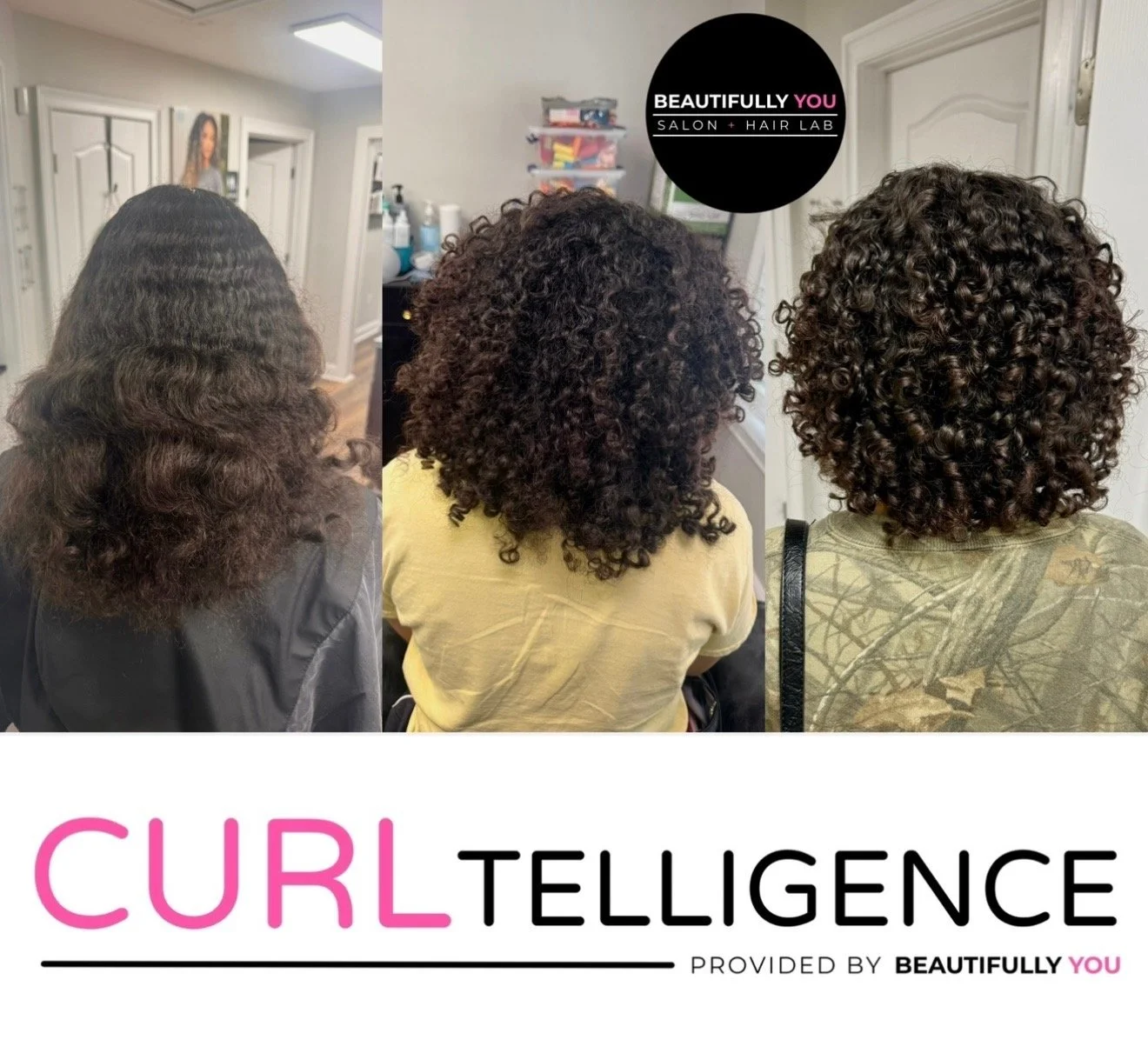
The first two pictures were taken just hours apart on the same day. The first is before restoration. The second is immediately after restoration, before a single hair was cut. The third was taken a few days later, after her haircut.
Look at those first two pictures.
Her curls became more defined. Her volume increased. Her hair contracted dramatically. She had already lost significant visible length without actually losing any hair.
But restoration revealed something else: the haircut she already had.
Look at the right side of the second picture. There is a significant hole in the shape that wasn’t clearly visible before restoration.
Now I could see it. More importantly, so could she.
Because we didn’t immediately cut, she knew I hadn’t created that hole with my shears. We could assess what needed correction, her goals and which techniques gave us the best path forward.
A few days later, we made the cutting decisions you see in the third picture. The shape is completely different, and even from the restored hair in the second picture to the finished result, look at how differently those curls present.
We weren’t cutting what we assumed her hair could do. We were cutting what her hair showed us it could do.
Equal length doesn’t always look equal on curls.
Most people don’t have one curl pattern behaving exactly the same way across their entire head. A tighter curl can sit beside a looser one. One section may contract significantly while its neighbor barely moves.
If I wet those curls, stretch them straight and cut them to exactly the same length, I’ve created technical equality.
I haven’t necessarily created visual balance.
That’s why shrinkage isn’t something I work around. Shrinkage is information.
I can cut a little, watch where the curl settles and decide whether it needs more. I use little to no tension because I need to see where that curl naturally lives. If I stretch it away from that position, I’m no longer cutting based on what it’s actually showing me.
Direction matters too. Neighboring curls can emerge, rotate, group and travel differently. If I can’t see those differences while cutting, I risk creating gaps, shelves, choppy layers or sections that don’t visually connect.
Curly cutting requires precision and sculpting.
You need both.
If you enjoy learning what your curls are actually doing and why, follow us on Facebook and Instagram. We talk about curl science and behavior so you can make better decisions about your hair instead of collecting more rules.
Dry cutting isn’t enough.
A stylist can cut every curl dry and still give cookie-cutter haircuts.
Learning one curly cutting system, even through multiple certification levels, gives a stylist expertise in that system. But curls don’t all need the same technique.
A curl specialist needs multiple techniques in the toolbox and enough understanding to know when to use them.
I may not even cut the same client exactly the same way from one appointment to the next. As the condition of the hair changes, its visible behavior can change too.
I have to cut the hair sitting in front of me today, not my memory of it from the last appointment.
And yes, sometimes I cut curls wet. Certain debulking techniques call for it. Razor work on looser curls and waves may call for it. Someone who regularly alternates between curly and straight may also require a different approach by dry cutting curly and then straightening the hair and fine-tuning.
The point isn’t that wet cutting or straightening is always wrong.
The technique should be chosen for the hair, not the hair forced into the technique.
Which brings us to what happens before I ever pick up my shears.
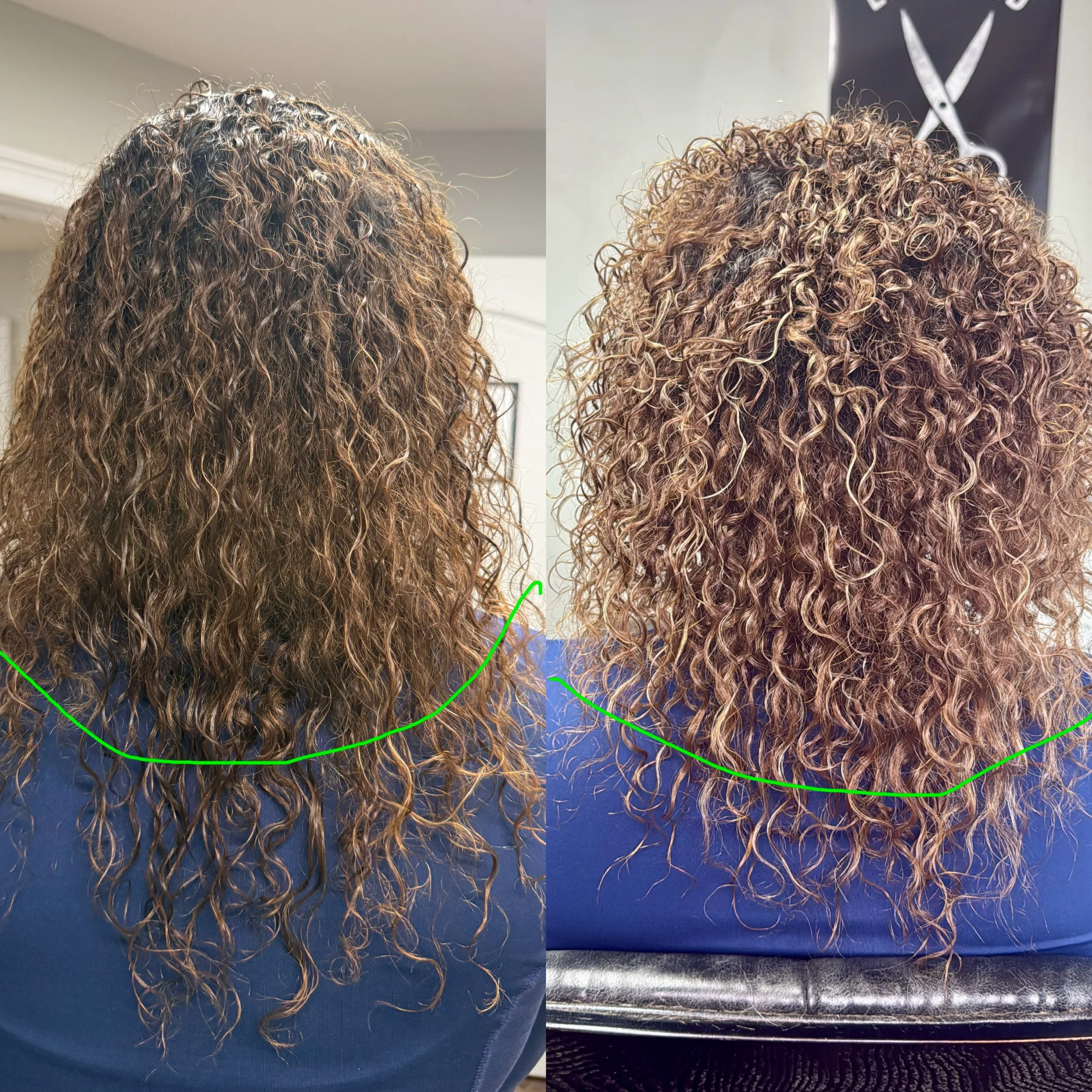
The green lines show approximately what I would have considered removing before restoration compared with afterward.
Same head of hair. Very different cutting decision.
She thought she needed to lose considerably more length. Once I could see her restored curls, I could see that we could preserve much more of it.
Had I cut first, there would have been no putting that hair back.
That’s why it is SO important to assess before your first cut.
Before we decide what to cut, we need to understand what we’re looking at.
We assess your hair and determine what it needs to prepare it for its first cut. That assessment guides the restoration so we can create the best possible starting point.
Restoration doesn’t promise that every curl will suddenly become tighter, and it cannot reverse every form of structural damage. It allows us to address what we reasonably can before making permanent decisions about what needs to go.
If buildup, mineral accumulation, product residue or other addressable factors are affecting how your hair presents, I want to see what happens when we address them first.
Some of what I’m seeing may be temporary. What I cut off isn’t.
So we assess. We prepare. We observe. Then we cut.
Because the goal isn’t to make your curls fit the haircut.
The haircut should fit your curls.
Now I want to hear: What is the one haircut you STILL tell people about, and what made it so bad? Tell us the story in the comments.
FOLLOW US