
Frizz by Any Other Name
If you’ve ever watched a good mystery, you’ve probably noticed that detectives are careful with their words. They don’t walk into a room, glance around for five seconds, and confidently announce who committed the crime. They collect evidence. They ask questions. They test assumptions. They understand that giving something a name too early can send the entire investigation in the wrong direction. Sometimes the quickest conclusion is the very thing that keeps the truth hidden.
I sometimes wonder what would happen if we approached hair the same way.
Every day, someone looks in the mirror, notices a few hairs that aren’t cooperating, and immediately reaches the same conclusion.
“Frizz.”
Case closed.
Except… what if it isn’t?
One of the greatest lessons science has taught me is that names can be deceiving. They often create the illusion that we’ve explained something when all we’ve really done is given it a label. Think about our analogy from last week. If you tell your doctor you’re in pain, they don’t immediately begin treatment because pain isn’t a diagnosis. It’s simply a description of what you’re experiencing. The real work begins with discovering why it hurts. I believe we’ve made the same mistake with the word frizz. We’ve spent decades trying to eliminate it without first asking what we’re actually looking at.
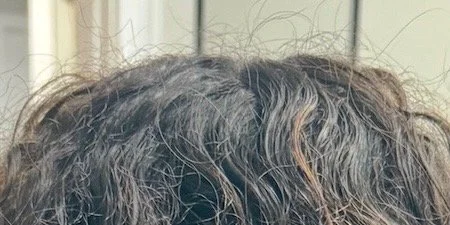
The first possibility is the one most people think of when the weather forecast calls for ninety percent humidity. Healthy hair is naturally protected by a thin lipid-rich surface that helps keep the outside of the fiber less receptive to water. As that protective surface becomes weathered over time, water can interact more readily with the hair, changing its mechanical behavior as humidity increases. Neighboring hairs that once moved together as organized curl groupings may begin responding differently, creating the appearance we recognize as humidity frizz. It isn’t that your hair suddenly decided to rebel. It’s that the conditions changed, and your hair responded according to the laws of chemistry and physics.
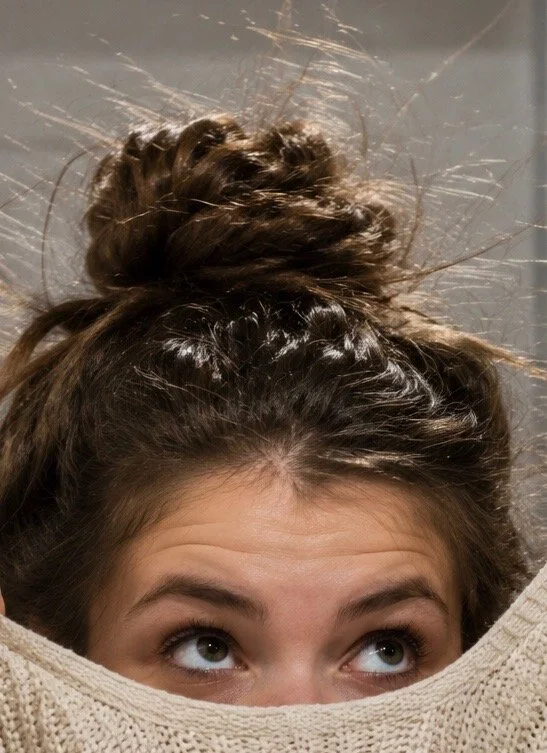
But that isn’t the only thing people call frizz. Think about the middle of winter when you pull a sweater over your head and suddenly a halo of tiny hairs seems determined to escape in every direction. That’s a different phenomenon altogether. Instead of humidity changing the behavior of the hair, friction between your hair and another surface creates electrical charges that cause individual hairs to repel one another. To the naked eye it may look surprisingly similar to what happened on that humid summer afternoon, but beneath the surface the mechanism is entirely different. If two problems arise for different reasons, it shouldn’t surprise us that they don’t always respond to the same solution.
Can I ask you something? Has someone ever looked at your hair, shrugged, and simply told you it was “frizzy” without explaining what they meant? I’d genuinely love to hear your experience. Leave me a comment below because many of my favorite articles begin with questions from readers just like you.
Then there’s a third possibility that I think deserves far more attention than it receives. Sometimes those shorter hairs standing away from the rest aren’t humidity frizz or static flyaways at all. They may simply be new hairs growing in, naturally different curl expressions, or normal variation in the individual fibers across your scalp. Modern hair research increasingly recognizes just how much diversity can exist within a single head of hair. Not every strand is identical in diameter, curvature, or behavior, and that’s perfectly normal biology—not necessarily a problem waiting to be fixed.
That realization changes everything. The little hairs you’ve spent years trying to smooth down may actually be evidence that your hair is doing exactly what healthy hair is supposed to do. If that’s true, then treating them as damage isn’t just unnecessary—it may even lead you toward solutions that solve nothing. The more I study hair science, the more convinced I become that our industry has sometimes confused normal variation with something needing correction. We see a hair that’s different from its neighbors and instinctively call it frizz, when perhaps we should simply call it… hair.
This is why I believe the most important question isn’t, “How do I get rid of frizz?” It’s, “What am I actually seeing?” Those are two very different questions, and they lead to two very different outcomes. One sends us searching for another bottle on the shelf. The other invites us to understand the remarkable biology growing from our own scalp. Understanding almost always produces better decisions than assumptions ever will.
If you’re the kind of person who enjoys discovering the why behind your hair instead of chasing the latest trend, I’d love to continue the conversation with you on Facebook and Instagram. I regularly share the science, research, and observations that continue shaping the way I think about curls, and I’d love for you to be part of that journey.
Perhaps Shakespeare was right when he wrote, “What’s in a name?” More than we realize. Sometimes the names we choose help us understand the world. Other times they quietly prevent us from asking the questions that matter most. I wonder if frizz has become one of those words. Not because it isn’t real, but because we’ve allowed one simple label to stand in for several very different phenomena. The detective in me isn’t satisfied with that answer, and I hope after reading this, you won’t be either.
So now I’m curious. The next time you look in the mirror and think, “My hair is frizzy,” pause for just a moment before accepting that conclusion. What are you actually seeing? Humidity? Static? New growth? Natural variation? Or something else entirely? Tell me in the comments below. Your observation may not only change the way you understand your own hair—it might become the question that inspires the next mystery we solve together.
FOLLOW US ON SOCIAL